HiEdVBA #1: Simple Lists

Lately I’ve been finding myself toying around more with Microsoft Excel — a piece of software that I’m sure many of us have wrangled with at some point or another. It turns out that Microsoft Excel is an exceptionally powerful piece of software.

One of Excel’s best kept secrets is Visual Basic for Applications1. At its core, VBA works like a programming language that can be embedded in Microsoft Office documents to certain tasks. I know, programming sounds really scary — but bear with me! It can be quite fun and even rewarding to become familiar with this feature of Excel*

The purpose of #HiEdVBA is two-fold — as always I want to document my learning as I explore new tools and technology. I also hope that as these VBA macros become more complex, folks are able to use them to enhance their workflow.

This week, I want to begin by creating a simple list. Working in residence life, I often am looking at a list of the residential communities on my campus (13 at the time this post was posted). Instead of writing out the name of each residential community and formatting the sheet to make it somewhat more visually appealing, let’s start by creating a VBA macro.

The first thing we need is access to the Developer tab in the Excel ribbon. It’s as simple as ticking a box — you just have to know where to look! We’ll go to File -> Options -> Customize Ribbon. You’ll see a list of the default ribbon tabs that you normally see. Let’s activate the Developer tab by making sure that box is ticked. Click “Ok” to exit this menu.

The Developer tab, once activated, will live in the ribbon along with the other features that you typically see.

There are two ways to create an Excel macro: You can either use the Record Macro button, or you can tell Excel exactly what you want to do using the built in text-editor. I reccomend you become comfortable with writing your code directly, as (1) the record macro feature spits out some extraneous information that just clutters your script and (2) it really empowers users to tinker and try messing with new ideas or concepts2. I’ll leave the reader to read further about storing macros in such a way that other Excel workbooks can access them3.

Under the Developer ribbon tab, select Macros -> Name Accordingly (I reccomend HallNames for this example) –> Create. You should end up with a minimalistic screen that looks like a text editor. Like any other text editor, be sure to save your work frequently and double check the details as you go.

Now, there are two things that we want to accomplish with this script. We want to nicely format a header for our spreadsheet and then follow that with a list of our residence halls. Let’s look at each of these components seperately.

Spreadsheet Header

Let’s start by creating a header for our spreadsheet.

Sub HallNames()

Sheet1.Range("A1:B1").Merge
ActiveCell.FormulaR1C1 = "Residence Centers"
ActiveCell.Font.Bold = True
ActiveCell.Font.Size = 14
ActiveCell.Interior.ColorIndex = 37

It looks like there’s a lot going on here, but it’s not so scary once we break it down.

Every VBA script begins with a Sub header — a name that we can use to reference the script that we’re about to write. After that you might be able to parse out that the 2nd line of code above is just merging two cells together. The remaining lines format the header cells in the following steps:

  1. Add the text “Residence Centers” to the newly merged cells.
  2. Makes the newly inputted text bold
  3. Changes the font size to 14
  4. Changes the cell background color to a light blue color.

Now we turn our attention to the last chunk of the script.

List of Halls

    Range("A2") = "Ashton"
    Range("A3") = "Collins"
    Range("A4") = "Eigenmann"
    Range("A5") = "Wright"
    Range("A6") = "USC"
    Range("A7") = "Forest"
    Range("A8") = "Read"
    Range("A9") = "Spruce"
    Range("A10") = "Wells"
    Range("A11") = "Willkie"
    Range("A12") = "Briscoe"

End Sub

You might find this bit of the script a bit easier to follow along with. Starting in Cell A2 we input the name of a residence hall (“Ashton”) and procede down the A column until we’ve entered all of the items that we want to list out. End sub marks the end of the script by telling Excel that we’re done adding commands to our script!

Conclusion

The result of running the complete VBA script we’ve created on an empty Excel workbook.

So why does VBA matter? I admit that after reading through this first entry in the #HigherEdVBA blog post series, you might not be totally convinced. After all, you could have easily decided to create an Excel template for the script we’ve created and be done with it. I purposely began with a simple example and script to illustrate some of the principles that undergird VBA. As our needs become more complex, we might find ourselves exceeding the limits of how much time a template can realistically save us. VBA scripts are also portable — they can be dropped into any Excel file and aren’t limited to one document.

1Due to security concerns, some institutions may prevent users from using .xlsm files, the filetype used to run an Excel Macro-Enabled Workbook.

2All materials for these tutorials are hosted on my GitHub profile, linked here. If you’re not familar with GitHub, it’s basically a Google Drive or DropBox for code with some pretty cool features. Also, I don’t intend on getting into the nuts and bolts of how to properly create these scripts — I’ll leave that to the reader to explore further if so desired. My primary aim with each of these series is to provide helpful scripts that folks can plug into their Excel workbook and run with.

3See the corresponding Microsoft Office documentation, linked here.
Starting to Learn the Bagpipes, a Prequel

As a sort of prequel to my bagpiping journey, I highlight the various events that ultimately set me on a fantastic journey that I never thought I would embark on: learning to play the Great Highland Bagpipes. From my  classical music upbringing to my father’s career as a New York City firefighter, this post was a chance for me to reflect on my path as a musician thus far.


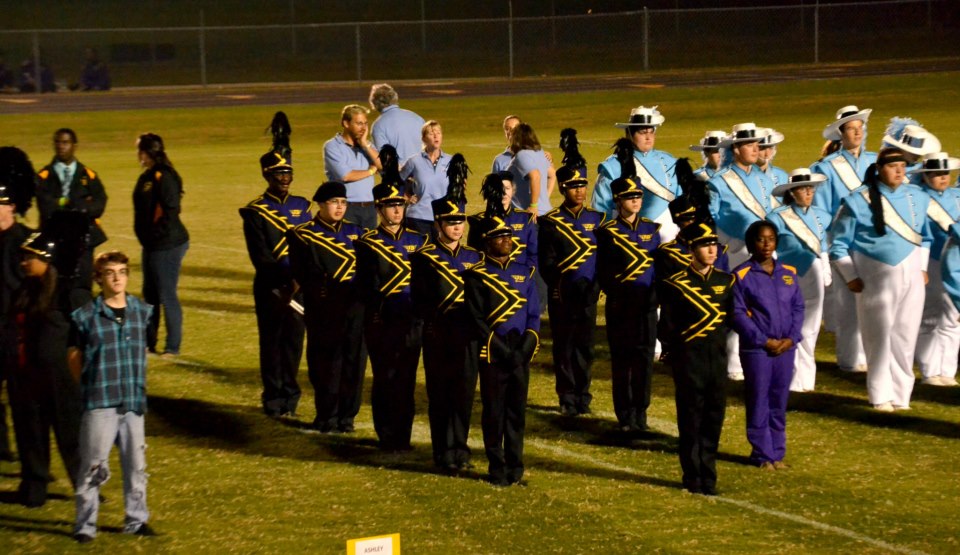
The section leaders from my high school marching band during an awards ceremony (wearing black/purple) circa October 2012. I’m the shorter fellow on the left with the beret.

I’ve been a musician my whole life. Never a professional by any means, but music was nevertheless a significant part of my youth and my identity as a young adult. I spent about 8 years playing violin and tuba, from all-county orchestras to jazz band to national marching band competitions. As poetic as I can be, I don’t think I can do justice to the sheer impact that music had on me, as well as the various music educators who it has been my privilege to learn from. As I embarked on my undergraduate education, music quietly faded into the background. I noodled around with the university pep band and played a few scales on the guitar from time to time, but I just didn’t commit to it like my earlier years.

“I’m learning to play the bagpipes.” is quite possibly the last phrase I ever thought I would utter. My family is certainly not Scottish (Italian, in fact!), and my only remote connection to the bagpipes is that my father is a firefighter in New York City. Over the years I’ve heard the FDNY Emerald Society Pipes and Drums a few times. During my first-year convocation at The University of North Carolina at Greensboro, the Jamestown Pipes and Drums began the ceremony with a lovely rendition of Scotland the Brave. This short performance and my periodic encounters with the Emerald Society marked the beginning of a sort of fascination that I had with the bagpipes. But these groups weren’t quite the catalyst for the start of my piping journey.

As I came back for my second year of graduate school at Indiana University, I felt a sort of gnawing feeling that I had to get back into music. As a tuba player, I had always wanted to play the snare drum in marching band. It turns out that most band directors want their good tuba players to remain on horn — can’t say that I blame them. I discovered the Bloomington Piper’s Society, and I thought it would be a fantastic way to start playing the drums with a proper group.

My first night with the Bloomington Piper’s Society. We we’re playing through some tunes in 4/4 and I was struggling to find my sheet music. A good time, nevertheless.

I joined BPS for a Pub Night, where the group sets up shop at a local bar or restaurant and plays the pipes and various other instruments. I managed to keep up with some of the drum scores, but the pipes are what really caught my attention. For the first time, I was in community with regular folks, having dinner, drinking a beer, and playing on the pipes. Something about that night rekindled my interest in the bagpipes.

Enter: Angus Martin. The BPS president, who is also a fantastic piper and involved in the local community. Not only is Angus a fantastic piper, he has such a passion for the piping community and helping others on their piping joruney. In fact, it’s hard to chat with him and not get excited about piping. I also thought it was pretty neat that we both work at Indiana University, albeit in different departments. Angus has been incredibly kind and supportive, exchanging various Facebook messages on piping basics, recommended tools, books, and more. In fact, I have my first proper lesson with Angus on Monday.

Overall, this post is a prequel outlining the various happenings that accumulated in my decision to properly learn the bagpipes. As I mentioned before, learning the bagpipes is something that I never thought would be on my bucket list. Nevertheless, I’ve begun learning, and am excited for the journey to come.

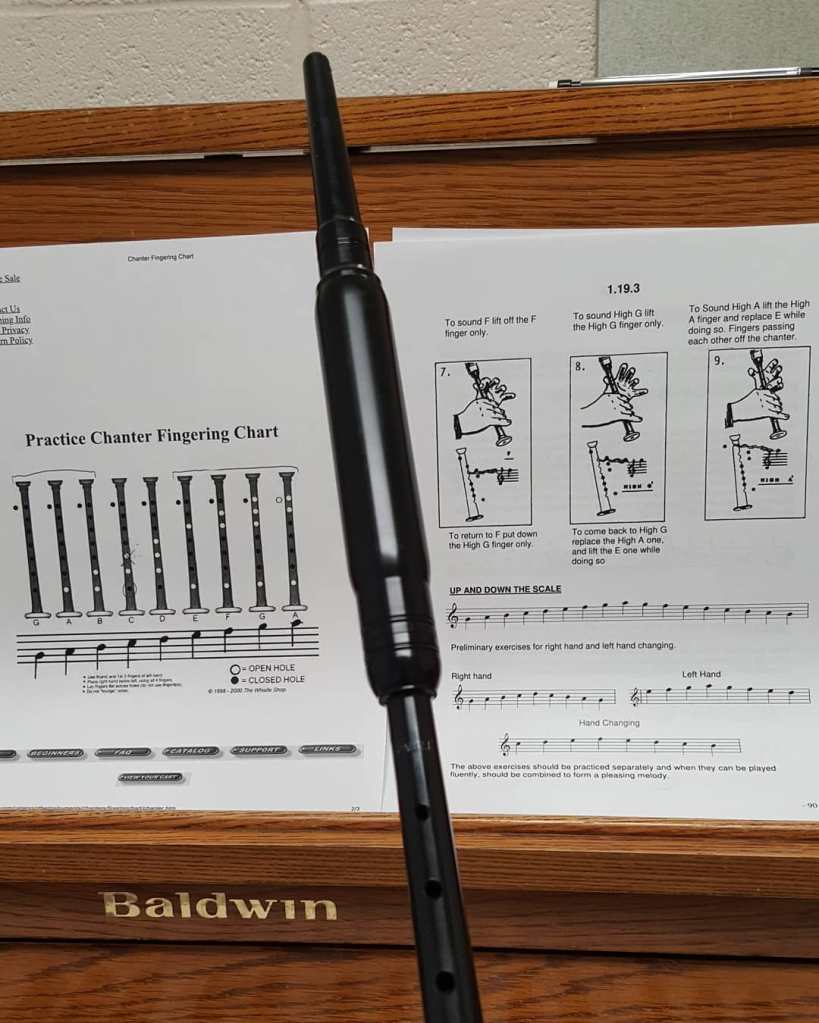
Working out of the tutorial book published by the Royal Scottish Pipe Band Association (RSPBA). Most bagpipe players spend 6 months – a year on the practice chanter (above) before progressing to a full set of bagpipes. Think of it like the recorders from elementary school with a reed inside.

Building My Toolkit: Python Pt. 3 (User Input and While Loops)


Building My Toolkit is a series in which I document my learning of various tech and data tools. Ultimately, my goal is to incorporate these skillsets in my role as an institutional research practitioner. Each week, I discuss the progress I’ve made with a particular tool, currently the Python programming language.

Up until now, the coding examples have been relatively static — meaning that I hardwired the code snippets to work exactly as I want to, and there is no input on the part of the user to direct the flow of a program. Naturally, you can imagine that this is not very realistic, as many roles in higher education rely on technology and the information that we input into our computers. Fortunately the Python syntax to prompt for user input is quite simple:


name = input("What is your name? ")

In this example, I use the input function to prompt the user for their name by telling the user what we want them to do. There are also ways to validate the data, such as checking to make sure that no integers are entered into the name field or we might use the title function to ensure that even if the user were to enter ‘JOE’, ‘jOe’, or ‘joe’, as names, they would each get passed into the program as ‘Joe’. Incorporating user input into future projects will allow me to create dynamic and user-driven programs, such as a simple text-based role-playing game. On a very fundamental level, the same sort of logic is at work when users enter their credentials into an e-mail client or other software.

Another handy feature that I learned about this week was the use of while loops. Essentially, while loops do what the name implies: While a condition X or Y (or both!) is unmet, a block of programming logic will continue to execute. For example:


current_number = 1

while current_number < 5:
    print(current_number)
    current_number += 1

In this example, I tell the program to print the current number to the terminal, which I initialize with a value of 1. As long as the number is less than 5, the program will add 1 to the current value and print the new number until the condition (number < 5) is satisfied. And so the result of this program would simply be:

1
2
3
4

This sort of logic is quite common in a variety of cases. The find and replace feature in Microsoft Office is a great example. As long as the program detects another iteration of the user’s query, the program will proceed to highlight and replace that iteration. Again, the logic is oversimplified here, but I challenge you to consider other ways in which the while loop logic drives other applications that you may work with.

So far, we’ve talked about all of the neat things we can do through programming logic, from continuing to loop through certain blocks of code to executing certain code based on a given value. Next time we’ll take a look at functions, which are handy ways to bundle various bits of code together in a handy way that we can call upon as needed in our program.

Post-Semester Check-In

Grades are in the books, and I’ve made it through my third semester in grad school. It was quite a slog, as may be evident by my relative inactivity on the site. Nevertheless, I wanted to check-in with a few thoughts and updates. 

Becoming a Scholar: This semester I took a course on college environments and assessment. The penultimate milestone for my program, it required my colleagues and I to work in teams to plan an original assessment project. Drawing upon our academic foundations in student development theory, diverse college students, and more, our study was titled “An Exploratory Analysis of the School of Informatics, Computing, and Engineering Living and Learning Community.” Working closely with program staff, my group developed this project to explore the gendered dynamics that exist within this STEM LLC. If you’d like to learn a bit more about the project, there are some documents available for download on my current projects/artifacts page.

Aside from the immense relief of accomplishing another semester in my graduate program, this semester was also a significant milestone in my development as a scholar-practitioner. I’ve always been enamored with the idea of being a scholar and producing original research. My time in grad school has propelled me forward in this regard, from learning the scholarly foundations of higher education and student affairs administration to the hours spent wrangling text in Microsoft Word to make sure my work met the necessary APA citation style. In many ways, it felt like this semester fit the final pieces into place. This manifested itself in small wins along the way, such as navigating IRB protocol and feeling comfortable doing a literature review. Within my own group, I worked closely with a colleague and provided most direction regarding research methodologies and data analysis.

I highlight these various items because these aren’t just things I wallowed through for the last semester trying to figure out. These are all components that my graduate program had been preparing me to do the entire time, whether I was cognizant of it or not. I could go on for days, but I’ll keep it short. My program has prepared me to engage in research. I’ve always had these various ideas bouncing around in my head, and I finally feel that I’ve achieved a scholarly foundation where I can go forth and put these ideas out there into the universe of scholarly ideas.

Finishing the IR Certificate: Let me preface this by saying that my decision to pursue the graduate certificate in institutional research is the greatest example I can think of where I made a decision on a whim only for it to become one of the most profound choices I’ve made, in both the personal and academic spheres of my life. Seriously, my internal thought process in pursuing this certificate was a thought process that went something as follows: “I have absolutely no idea what this program is, but it sounds sort of  cool, why not?” I wish I had a more grandiose, epic reason for choosing the IR certificate, but alas, here we are. I had no idea at the time that the program would open up a whole new world of higher education to me. In many ways, the IR certificate confirmed my inner hunch that a career path in assessment and institutional research/effectiveness was the best fit for my professional trajectory. It also helps to be in a graduate preparation program with brilliant faculty. Seriously, how many people can say that their professor is the project director for the Carnegie Classification?

Statistics: I never thought I’d be a huge fan of math, much less statistics for that matter. Naturally, an introductory statistics course is a requirement fore the IR certificate that I talk about above. You can imagine my surprise in discovering that I enjoyed so much that I decided to take multivariate stats as an elective in the spring 2019 semester. Starting to learn stats this past semester was one of the happiest accidents to have happened, as I’m fairly certain I would never have done so were it not required of me. Prior to taking statistics, I would glaze over the methods section of various papers in my field, not really understanding different types of statistical tests or what it means for a result to be statistically significant. I’ve even found myself recently speaking diatribes on why we need more statistical competency in our graduate preparation programs and the field as a whole (but I’ll save that for another day).

Overall, the common theme of this semester was another continuation in my story of becoming — becoming a better scholar and practitioner than I was last semester or even last year. The last semester has taught me a lot about where I fit inside of the large higher education ecosystem, and I’m excited to see where this journey will take me. I’ve got some exciting projects planned for 2019, so I hope you’ll stay tuned!

Thanks for reading,

-Joe

Changing Assistantships: From Living-In to Living-On

If you had asked me a year ago what sort of trajectory I wanted my professional career to take, I would have emphatically said residential life. I had been heavily involved in housing leadership roles and employment opportunities throughout undergrad. In many ways I took a very cliché route by going from hall council to RA to graduate RD. I had the perfect path planned out to a fulfilling career in student housing. For all intents and purposes, I fit the typical “mold” of how many residence life professionals rise up in the field.

Unbeknownst to me as I began my first training session for my live-in assistantship in July 2017, several things would transpire that year that ultimately set me on a very different path from the one I envisioned only a year ago.

The Graduate Certificate in Institutional Research: My decision to pursue the Graduate Certificate in Institutional Research was a complete fluke that turned out to be the second-best choice I’ve made in my academic career (after joining the HESA program at Indiana University, of course). My decision to take the introductory IR course introduced me to a whole new world that opened up within the realm of higher education, a truly exciting world of data sets, analytics, and more. Through the course, I was able to connect with some folks that are doing incredible work with in the field. I always had a strong interest in data and analytics from the few courses I took in computer science as an undergraduate. It felt like the IR certificate program empowered me to discover this magical and alluring field that existed right at the intersection between data and education.

My Summer 2018 Internship Experience: During summer 2018, I interned with University Housing at Florida State University to support the needs of their conduct and assessment program within the Residential Student Experience Team This was such a unique and wonderful position, as it is one of the few ACUHO-I internship experiences that don’t deal with managing a summer school residence hall or a camp operation. My involvement with camps and conferences will always have a special place in my heart, but it was incredibly satisfying to immerse myself in Skyfactor data and to gain an understanding of the role of data and assessment within a residential life unit.

The Chance to Pursue a New Professional Opportunity: I’m incredibly appreciative to the director of my department working with me to create an assistantship experience that would be more congruent with my shifting interests and passion areas within higher education. I saw an opportunity to support my department in a new and exciting way, and we were able to forge my new role. For the next year or two that I hold this position, I hope to demonstrate the value of keeping this assistantship available to support my department’s data and assessment needs.

While I approached my new assistantship with a healthy amount of caution, particularly a fear of the unknown that comes with establishing a new graduate assistantship, I can look back in the last month alone and say that my new assistantship working with residential life assessment has been one of the highlights of my young career as a college student educator.

Just to highlight a few of the things I’ve been able to work in as I approach one month in my role:

Supporting Assessment Initiatives for the Residential Curriculum: Working in a live-on role has given me a bird’s eye view of how my department operates, particularly with regards to the role that our residential curriculum plays in the student experience. Without the additional responsibilities that come with direct supervision of student staff, I am able to commit much more time to thinking about the curriculum and how the work of my supervisor and I help to “tell the story” of what it is that that our residents are learning within their communities.

Cultivating Strong Partnerships with Campus Partners: One of my charges has been to identify and cultivate particular areas of our work that could be prime sites for collaborative efforts. One of the fantastic things about being in an assessment role (particularly at a large institution like IU-Bloomington) is that the data infrastructure of the campus is so incredibly complex, with a variety of units that work together to meet the data needs of the University. Just a few units on campus that I have been able to connect with include: the Center for Learning Analytics and Student Success (CLASS), Bloomington Assessment and Research (BAR), the Center for Innovative Teaching and Learning (CITL), and the Office of the Vice Provost for Undergraduate Education (OVPUE). With each of these campus units I’ve been able to represent the amazing data work taking place within Residential Programs and Services, and to get phenomenal insight into how other data-driven units operate.

All Things Data: It’s no secret that I think data is super fascinating. It allows us to tell the stories of the learning that we facilitate as college student educators and it seldom lies (barring any methodology errors or bias, but I digress). My new role allows me to immerse myself in the data, to generate new data, and to make sense of the data that web obtain.

As I transitioned into my new role, I was worried that I would terribly miss the supervision and student engagement component of my previous role, and I certainly did. The key to assuaging that feeling has been identifying areas or projects where I could provide leadership and apply a similar administrative skillset. While I found that with my residential curriculum assessment initiatives, I was thrilled to be recently tapped to develop and administer the  Thrive@IU program, which seeks to provide access to an IU education while empowering students with professional development and leadership skills. I anticipate a cohort of around 30-40 students, and I can’t wait to meet them in the coming weeks. The program is very near and dear to some high-ranking administrators on my campus and it’s quite exciting (and somewhat nerve-wracking) to know that I have the potential to mold this new program that many administrators are keeping an eye on.

My official title is “Graduate Assistant for Assessment and Special Projects.” I’ll admit, it may sound dry to many of my colleagues. Nevertheless, it truly is the most dynamic role that I’ve held, even compared to my previous assistantship as a traditional in-hall graduate supervisor.

I still have a special love for residence life, and I’ll still likely begin my career as a student housing professional. If there’s anything that my first year of grad school taught me, it’s where my true passions and professional interests lie. That’s something that you can’t put a price on.

At the end of the day, I view myself as a storyteller. I wrestle with data sets, surveys, and whatever else may wander across my desk to tell the story of the dynamic student engagement that takes place in the residential communities at Indiana University-Bloomington. I truly can’t imagine a more worthwhile charge than that.

Thanks for reading,

Joe

WelcomeWeek18
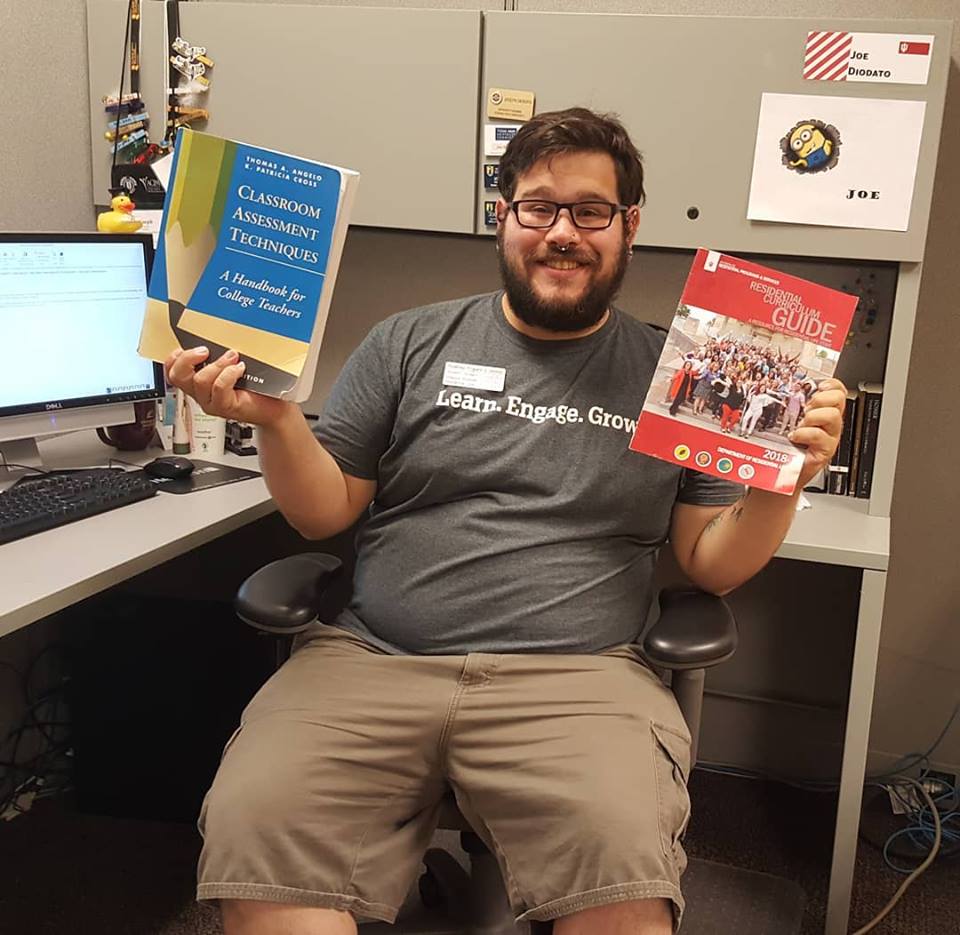
In my office during move-in week, working hard on creating some assessment resources for the department.


Building My Toolkit: Python Pt. 2 (If Statements and Dictionaries)

Building My Toolkit is a series in which I explore my learning of various tech and data tools. Ultimately, my goal is to incorporate these skillsets in my role as a student affairs practitioner. Each week, I discuss the progress I’ve made with a particular tool, currently the Python programming language.

The last week or so has been a really exciting time in my fledgling programming career. The programming problems that I’ve been working on out of the Python Crash Course have become noticeably more complex, offering many possibilities for how to tackle a given program. I’m particularly excited that I got to tackle if statements this week, as they are a great supplement to for loops. In addition, they let me know that tackling while loops isn’t too far off on the horizon.

If statements are pretty straightforward — they instruct a computer program to execute a command if a certain condition is met. The below code snipped illustrates a rather simple usage of an if statement.


for student in student_list:

if student_age 

    print("This student is underage!")

else:

    print(student_name)

The above snippet would loop through a list of students and print the name of each statement. The use of the if statement here directs the program to let me know if a student is underage. This is a simplistic snapshot of some of the backend logic with Maxient, Advocate, and other conduct management software programs.

Another example of if statements working behind the scenes is the condition feature in Excel. As higher education administrators, we practically live in a world of spreadsheet at times — or so it feels. A simple if statement helps on the backend of Excel to check whether certain cases are true.

I could also use pseudocode — a high-level outline of a computer program or algorithm to show what the programming logic for a simple conditional formatting might look like.

# Pseudocode that outlines the logic for a basic conditional formatting
# operation in Excel Loop through each cell selected by the user

Loop through each cell selected by the user
For each cell:
if the cell == null # Meaning that the cell does not contain any value
Change the cell shade to light red
else: Change the cell shading to light green

In my studies from the past week, I also explored dictionary data structures, which are used to connect related pieces of information. For example, I could create a dictionary of student development theorists and connect the theorists’ name to their respective theory as follows:


theorists = {

'schlossberg': 'transition theory',

'kohlberg': 'moral development',

'chickering': 'seven vectors',

'sanford': 'challenge and support',

}

At their core, dictionaries are composed of key-value pairs. Essentially a key-value pair is jargon for two pieces of data that are connected. The above example is a dictionary called ‘theorists’ and contains a total of four key-value pairs. Each pair of data is conjoined with a colon, with single quotes used to set off each piece of data.  Dictionaries are nifty in that their functionality can be scaled up in a number of ways. For instance, we could use a list to associate a number of theoretical ideas with a particular theorist. Let’s revisit Schlossberg’s transition theory. Instead of having one value associated with the key ‘schlossberg’, we could associate the four S’s of her theory with the same key.


'schlossberg': ['situation', 'self', 'support', 'strategies']

I could go on down the rabbit hole of possibilities with dictionaries, but I think I’ll stop there. It’s exciting to be getting to a part of my programming journey where there are more nuanced decisions to be made about how I approach a given task. I think my next post in this series will be a real treat! I hope you’ll join me as I look at some more programming logic, building some nifty programming blocks, and how to take  user input right from the keyboard.

Thanks for reading,

Joe

Are you interested in giving programming a try for yourself? Check out this link for a brief Ruby tutorial. Ruby is a high-level programming language that is similar to Python. Let me know if you got the chance to check it out!

Let’s connect on Twitter @joe_diodato.

Building My Toolkit: Python Pt. 1

Building My Toolkit is a series in which I explore my learning of various tech and data tools in higher education administration. Ultimately, my goal is to use these skills in my role as a student affairs practitioner. Each week, I discuss the progress I’ve made with a particular tool. The series will begin with my exploration of the Python programming language

Very few folks know that I spent a year and a half as a computer science major while I was at UNC-Greensboro. While I did not graduate with a comp sci degree, my coursework provided me with several traits that have stuck around, namely a love of technology and exploring the unknown. Until very recently, I viewed my computing experience as worlds apart from higher education. I would later learn that my programming background could be a tremendous asset in higher education.

During my first year in the higher education and student affairs program at Indiana University, I took the plunge and enrolled in EDUC-C661: Foundations of Institutional Research. Surrounded by brilliant colleagues, I developed a love and appreciation for the role of data and technology in institutional decision making. With my curiosity piqued by exploring tools such as the Integrated Postsecondary Education Data System (IPEDS) and learning the basics of data visualization in Excel, I began to desire more. I dug out a book on the Python programming book that I had and got to work.

51f48hfhq6l-_sx376_bo1204203200_
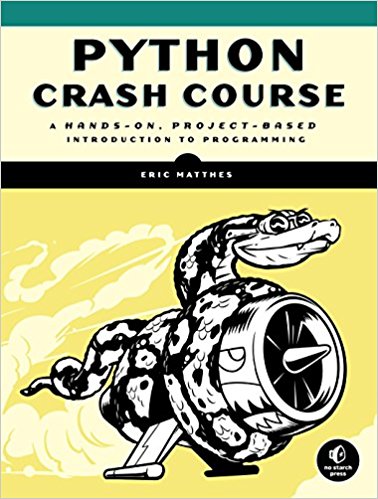
Python Crash Course

I love Python Crash Course and the structure of the book. It begins with eleven chapters that introduce the basics of the Python programming language, followed by projects that touch on a variety of areas, including basic game design, data visualization, and web development. Of course, the data visualization features of Python are of the most interest to me at the moment.

 Hello, world! 

Hello world — the first program of many aspiring software developers. This simple script introduces the programming terminal and ensures that the proper dependencies and packages are installed in the programming environment.

I then began to learn the basics of variables and data types, and how they are utilized in a computer program. For example, the below code snippet creates a variable called “message” and stores a sentence in the message. After the string (sentence) is stored in the variable, it is then printed to the terminal.

message = "Python rocks for data analysis!"
print(message)

This could will yield the following output:

 Python rocks for data analysis! 

For the last of this round of exercises, I began to learn about lists. Put simply, a list in computer programming is a collection of things in a specific order. It could be a collection of symbols, letters, numbers, sentences, or anything else. There are many ways to manipulate lists, such as the below example that creates a short list of student development theorists.

theorists = ['Chickering', 'Magolda', 'Perry', 'Kohlberg']

Lists are defined similarly to how we defined the message variable in the second example, except this time we would add brackets to indicate that the items are a list. I can manipulate the lists in various ways, even using an indexing system to refer to certain elements of the list. List indexing in programming starts at zero, so I would refer to element 0 ([0]) to utilize the first element of the above list.

print(theorists[0] + " wrote the seminal text Education and Identity."

This snippet would print in the terminal:

 Chickering wrote the seminal text Education and Identity." 

Overall, I’ve only scratched the surface of what is possible in the Python language. Over time these building blocks will become progressively more complex as my competency in programming continues to develop. I’m excited to continue documenting my learning of the Python language, and I hope that you continue to follow along. Perhaps we may even collaborate on a software project in the near future.

Thanks for reading,

-Joe


On Choosing Joy

In the film adaptation of Harry Potter and the Prisoner of Azkaban, Professor Dumbledore begins the start of term feast with his usual allocution, providing students with various words of advice and caution. In what I think is one of Dumbledore’s more brilliant sayings, he tells the students that ‘Happiness can be found even in the darkest times if one only remembers to turn on the light.’ In many ways, I know I need to do a better job of keeping this tidbit of knowledge in my consciousness.

The idea that I could thrive and experience joy always seemed to elude me. As I embarked on my undergraduate studies, I began to seek counseling to work through symptoms of anxiety and depression. I began to attend counseling on an uncertain basis, choosing to skip sessions for one reason or another. If there’s one thing that I was good at, it would be coming up with a myriad of seemingly rationale reasons as to why I would miss a counseling session. I justified my missed sessions by pointing to how bad the weather was and I didn’t want to walk across campus or by telling myself that I was fine. Frankly, I didn’t know what fine was. Some days I still don’t.

It wasn’t until this past academic year, my first year as a graduate student at Indiana University, that I firmly committed to my mental and emotional health. I resumed therapy with a fantastic clinician in the counseling center. On March 14th, 2018 my life changed for the better. After several counseling sessions, my counselor referred me to psychiatric services to be evaluated for any underlying conditions that could be exacerbating my mental health. After a few psych sessions, I was prescribed antidepressants to help with depression, anxiety, and the acute insomnia that I developed during my first year in graduate school. Out of the spectrum of experiences and feelings that I processed with my counselor, we pinpointed the most severe of my symptoms as stemming from various triggers in my graduate assistantship.

I know it must seem strange to read this piece about choosing joy after I just finished laying out the summary version of my mental health journey, but I ask you to bear with me for just a few more minutes. I promise that things will come together.

As I think of where I go from here, I’m particularly appreciative for the insight offered by the late Dr. Randy Pausch, former professor of computer science at Carnegie Mellon University. After Dr. Pausch was diagnosed with pancreatic cancer, he delivered his last lecture. During the lecture, he shared a very profound bit of wisdom that I will always remember: “It’s not about the cards you’re dealt, but how you play the hand.”

On the threshold between my first and second years of my grad program, I find myself with a  hand of cards that I’m not fond of — some changes to my assistantship that are the result of misunderstandings and confusion; situations and conversations that have played out in such a way that I genuinely believe to be unfair at best.

It is here that I return to joy. This once abstract phenomenon turned tangible and accessible to me. As I’ve hinted at here and in my first blog post, my first year of graduate school did not go or end like I thought it would. As I ponder this threshold of my academic career, the hand of cards that I’ve been dealt, I’ve committed myself to focusing on how I will play this hand. I focus on how I will continue to thrive in my work as an emerging student affairs educator. I’m particularly indebted to a fantastic internship supervisor here at FSU and an amazing new best friend that I’ve found here in Tallahassee for always being there to support me and to serve as a sounding board for whatever might be preoccupying my mind.

My plan is very simple — I’m going to do the best possible job I can in my assistantship in the upcoming year. I will continue to take a scholarly approach to my practice as a student affairs educator. I will meet or exceed all expectations that are set of me. My internship at Florida State University has been nothing short of an amazing experience thus far and truly transformative in helping me grow and develop to meet the challenges that year two in my graduate program will bring.

Dumbledore reminds us: “Happiness can always be found when one remembers to turn on the light.” Today and every day, I commit myself to turning on that light — to thrive and to be my authentic self. The road may have been rocky so far, but I’m just  getting started. I hope that you’ll stick around for the ride.

Thanks for reading,

-Joe


Aristophanes in the Academy: Reflections of Antiquity in Student Affairs

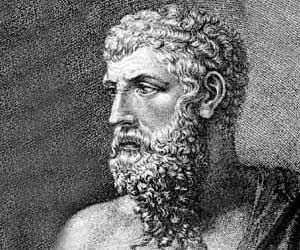
Aristophanes
Aristophanes, Greek playwright and “The Prince of Ancient Comedy”

The humanities, particularly classical studies, have gotten a bad reputation in higher education. Often belittled in comparison to academic programs that are more in demand on a given day, one of the greatest shames in higher education is that I consistently have to defend my liberal arts degree. Far more eloquent writers than I, such as Fareed Zakaria, have written extensively on the value of the liberal arts.

While I am a graduate student in an education program, the ancient world still captures my interest with its vivid characters and poignant lessons about the common humanity that we all share. As I reflect on what makes the ancients so vivid and real to me and countless others who have studied antiquity, I realize that I see so much of myself, my students, and our society in the ancient world. Some parts of the human experience are truly universal — questions of ethics and morality, love, faith, etc. The list goes on, and some of the greatest thinkers of all time have wrestled with the same questions over the  last few millennia.

Specifically, I see so much of the work that I engage in as a student affairs practitioner rooted in ancient thought. When I facilitate conduct meetings, I imagine Plato’s allegory of the cave, and what he might say about the moral and ethical dimensions of student development. Aristophanes, Euripides, and countless other Greek playwrights have modeled for us what it means to be a good human, how to work through feelings of love attachment, and the value of humility. I could go on, but I think you get the idea.

I admit that I previously saw classical studies and student affairs work as an either/or proposition. Both fields resonate strongly with my passions and interests, but it wasn’t until very recently that I was able to imagine them as complimentary. I found myself thinking about the intersection between these areas so often, it almost seems like a disservice to myself if I don’t critically reflect and wrestle with their implications for education.

Over the next few months, I hope to launch a digital resource that exists in the borderlands between antiquity and student affairs work. My aim is to make the past more accessible to those who wish to explore it and wrestle with what it has to teach us. While my academic background is in classical studies, I recognize that there is a wealth of knowledge that existed outside of the Mediterranean basin. In doing this project, I want to avoid epitomizing Western civilization as the root of all knowledge and wisdom. This project would be ripe with opportunities to collaborate with colleagues across a variety of areas, particularly educators with humanities backgrounds. Incorporating principles from the digital humanities will further make this project more accessible and easy to navigate, and I hope that my budding interest in computers and programming will allow me to try out some really interesting ideas.

So often, student affairs professionals talk about the need to humanize the educational process — to create space for populations who have been historically disenfranchised and to properly disrupt a system that is beyond broken. Amidst countless calls to action, the knowledge passed down to us from antiquity seems to be a stone seldom turned over. What if we as a profession did just that? What if the ancient world could provide us with the tools to re-imagine education? As we wrestle with questions of morals and ethics, right and wrong, love and loss through the eyes of the ancients, maybe we can begin to change the system and discover our true human and educational potential along the way.

Thanks for reading,

-Joe


Halfway to Hooding: Reflections on Year One as an #SAGrad

Briscoe-staff
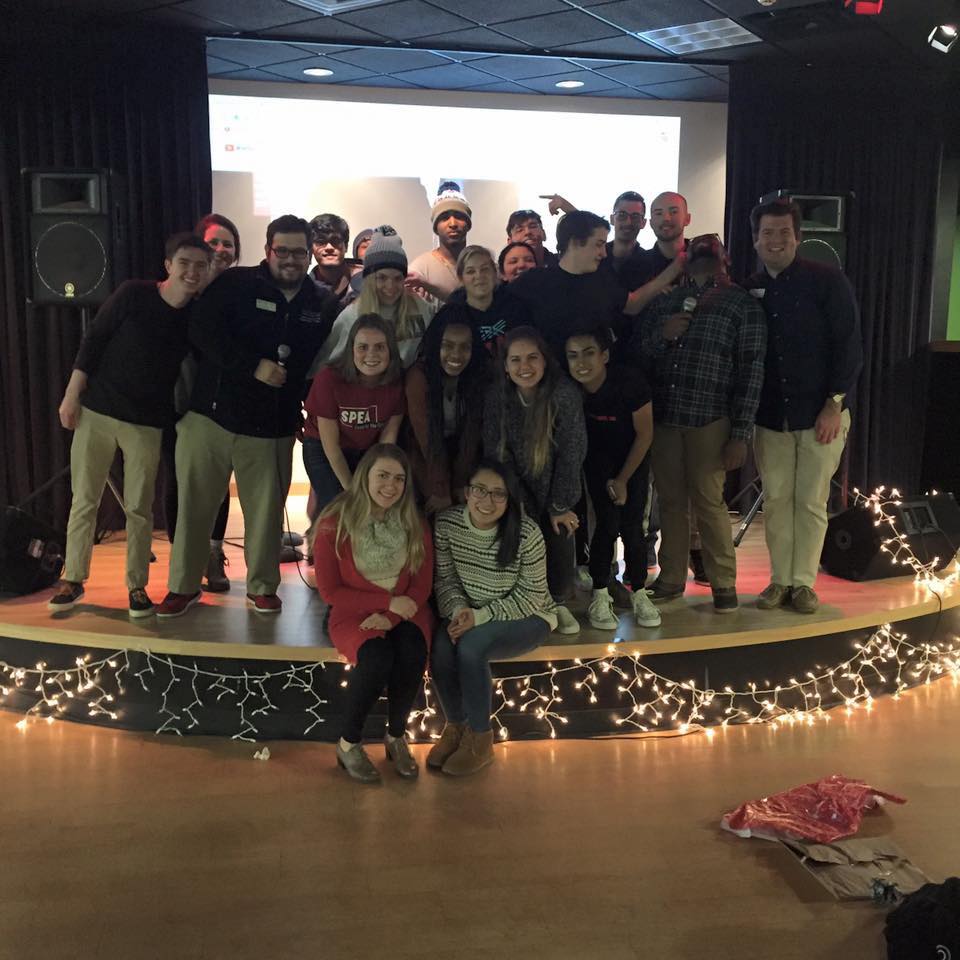
The phenomenal staff that I worked with during the past year. I definitely couldn’t have made it through the year without their support, understanding, and grace.

Looking back on my first year in graduate school, I can honestly say that my first year didn’t go exactly how I thought it would. I had developed a rather glorified view of student affairs and higher education, nurtured by the perceptions of the field I had fostered as a super-involved undergraduate student leader. On one hand, I’m actually glad that I encountered various difficulties this year in my program, as it was these roadblocks that challenged and pushed me to grow as a young professional. How timely it was that our professional development seminar took place during my second semester, allowing me to first-hand apply the various theories and frameworks that we studied. While I could probably write a tome on lessons learned this past year, there were definitely five themes that were the most poignant as I reflected on the past academic year.

Supervising Student Staff: Student staff can be incredibly unforgiving. Innocent first-year supervisory mistakes easily become distorted and blown out of proportion, and at times it can be incredibly difficult to be viewed in a supervisory manner, particularly when some of the students I work with were my own age. First-year grads are often warned about navigating relationships with students that are in the same age bracket, but nothing really prepared me for cultivating that professional relationship aside from just going for it, accepting feedback, and listening to more seasoned colleagues. At the end of the day, I worked with some pretty amazing students during my first year in graduate school. They’ve challenged and taught me so much, and I hope that they feel the same way about me.

Navigating Relationships: Relationships can be tricky in graduate school, where it’s easy to become caught up in classwork, assistantships, and practicum experiences. There’s no mandate to develop close meaningful relationships, and I’ve probably had to work harder than ever to develop my close group of friends in my cohort. While it took me a semester to find my close-knit group of friends. Surprisingly, each of them worked in different offices outside of residential life. By and large, that has been a tremendous asset to how I process through various life and work things that have arisen.

Institutional Politics: Navigating institutional politics is something that I’m still learning to be comfortable with. Really, it wasn’t until my second semester that I was even concerned with institutional politics as I began to see more of the inner workings of the institution, including the good and bad that comes along with that. These experiences have been formative in helping me to view my summer internship through a political and structural lens as I continue to grow in my role and learn how I fit into my current department.

Everyone won’t be a friend…and that’s totally fine: One of my greatest weaknesses is that I try to see the good in everyone and to genuinely be at least friendly with my peers and colleagues. Of course, that isn’t always reciprocated. And that’s totally alright. Whether a conflict is with a colleague or other staff member, I genuinely strive to see the good in every interaction and to center that as my main takeaway.

Authenticity: In summation, the biggest lesson I learned from this year is to honestly be myself at all times. It sounds cliche, but I think it really took the experiences that I’ve had this year to cement this lesson in my mind. I’m a really dorky, nerdy, sometimes clumsy and awkward person. I care so much about the work I do and the students that I serve. While I am a very internal processor, I view the relationships that I form are the foundation of my success as a young student affairs professional. Who I am when people engage with me is honestly who I am. At times, I’ve had some really hurtful interactions, some due to my own mistakes, but no one that knows me can say that I’m not a caring and dedicated professional.

It bears saying again that I was only able to grow the way that I have over the past year as a direct result of my shortcomings. I genuinely view each interaction as a learning opportunity, and I certainly have grown a lot this year. I couldn’t have done it without support from my close friend group and a variety of professionals in my department and beyond who have offered their time, expertise, and good will to help me continue my development as a professional. I’m truly appreciative for the village that has invested in my success, and I’m excited to see what year two has in store.

Thanks for reading,

-Joe